
Introduction: The Manufacturing Bottleneck in Fitness Equipment Production
In the highly competitive global fitness equipment manufacturing sector, structural integrity and production efficiency are the twin pillars of success. A leading Vietnamese manufacturer of commercial treadmills, power racks, and elliptical machines recently faced a severe production bottleneck. Their traditional methods of drilling and threading thin-walled carbon steel tubes (1.5mm to 3mm wall thickness) using manual drilling combined with weld nuts or rivet nuts were slow, labor-intensive, and prone to high defect rates. By transitioning to a custom thermal friction drill system from Duomi CNC, they completely eliminated weld nuts, reduced their defect rate from 4.5% to under 0.1%, and boosted overall output by an astonishing 210%. This case study explores the technical transition and the immense benefits of advanced thermal drilling technology.
Background: Why Weld Nuts and Rivet Nuts Fail in High-Vibration Applications
Commercial fitness equipment undergoes continuous, high-impact dynamic loads and severe vibrations. To withstand these forces, the structural frames—typically constructed from square or rectangular carbon steel tubing—require dozens of highly secure threaded connection points. For years, the industry relied on two primary fastening methods, both of which present significant manufacturing and quality challenges:
-
Weld Nuts: While offering high pull-out strength, the welding process introduces extreme localized heat into thin-walled (1.5–3mm) tubes. This heat inevitably causes thermal distortion, warping the tube profile and misaligning the threaded holes. Furthermore, welding requires highly skilled labor, post-weld slag grinding, and rust-prevention treatment, making it a slow and costly process.
-
Rivet Nuts (Rivnuts): Rivet nuts are faster to install than weld nuts, but they rely entirely on a mechanical crimp. Under the constant vibration of commercial treadmills or heavy-duty power racks, these rivet nuts frequently loosen and spin within the hole, rendering the fastener useless and creating a major product liability risk.
The Vietnamese manufacturer was running both methods across multiple manual production lines. Each line required three separate stations (drilling, welding/crimping, and grinding) staffed by three skilled operators. This workflow capped their output, introduced significant quality variance, and resulted in a costly 4.5% rejection rate at final inspection. They needed a modern, automated solution for drilling and threading that could deliver speed, consistency, and structural integrity.
Deep Technical Analysis: The Science of Thermal Friction Drilling
To solve these challenges, Duomi CNC introduced the concept of thermal drilling (also known as flow drilling or friction drilling). Unlike conventional drilling, which cuts away material and leaves behind thin, weak walls, a thermal friction drill works by displacing the metal rather than removing it.
The process utilizes a specialized tungsten carbide tool rotating at high speeds (up to 6,000 RPM) under high axial pressure. As the tool contacts the carbon steel tube, the intense friction generates localized heat (approximately 600°C to 800°C), rapidly plasticizing the metal. As the tool penetrates, it pushes the softened material downward and outward, extruding a perfectly formed cylindrical collar or bushing. This collar effectively increases the local wall thickness of the tube by 3 to 4 times.
Immediately following the drilling phase, a cold-forming roll tap is introduced to form the threads. Because the material is displaced rather than cut, the grain structure of the metal is preserved and compacted, resulting in threads with exceptional load-bearing capacity and pull-out resistance. The entire process is clean, produces zero metal chips, and requires no external fastening hardware.
The Solution: Duomi CNC's Custom 5-Meter Thermal Friction Drill Center
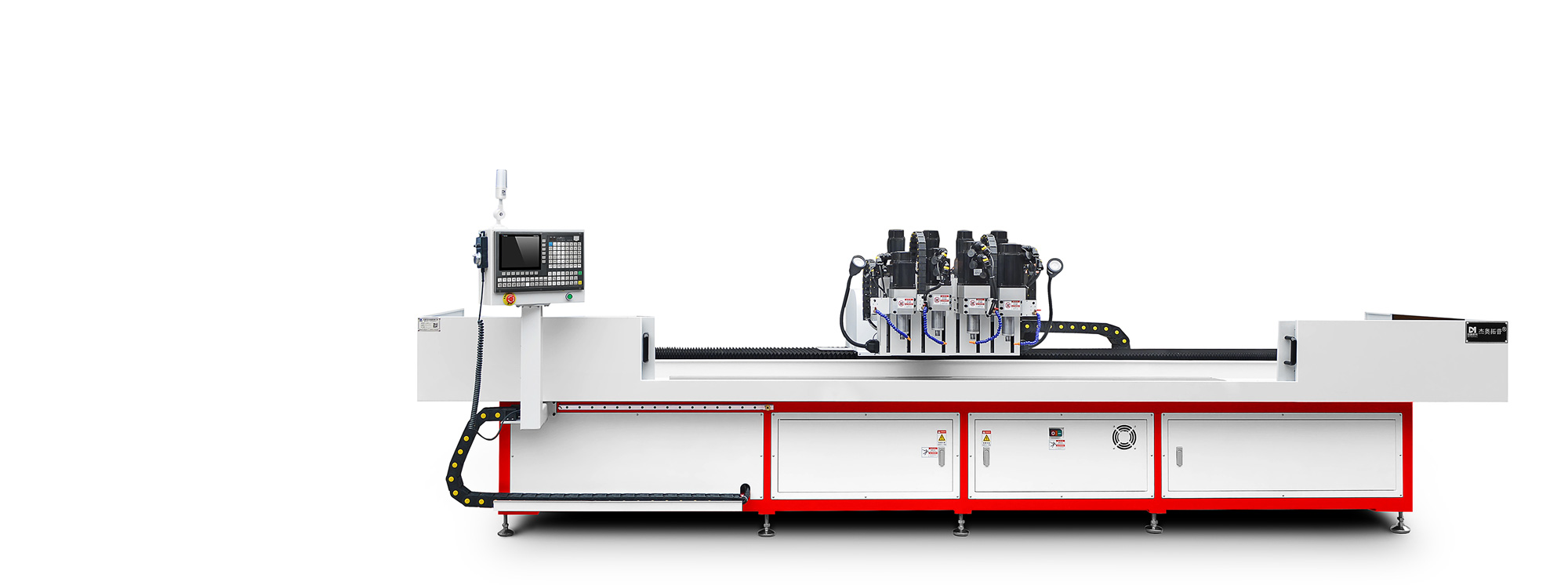
Duomi CNC's engineering team designed a custom solution tailored to the client's exact production floor layout and product specifications: the DHM-4030DT Thermal Form Drilling Machine. This high-performance CNC center features a dual-zone pendulum worktable and four independent spindles to maximize throughput and eliminate downtime.
1. Dual-Zone Pendulum Processing
The 5,000mm X-axis worktable is divided into two independent processing zones (Left Zone and Right Zone) equipped with 8 heavy-duty pneumatic clamps. While the CNC spindle assembly is actively performing drilling and threading operations on tubes in the Left Zone, the operator safely unloads finished parts and loads raw tube stock in the Right Zone. Once the Left Zone cycle completes, the spindle assembly instantly transitions to the Right Zone. This continuous pendulum workflow completely eliminates operator loading idle time, keeping the machine cutting continuously.
2. Four-Spindle Layout Eliminates Tool-Change Downtime
The manufacturer's product catalog required two distinct thread specifications (different hole diameters and pitches) across their product lines. Traditional CNC machines require automatic tool changers (ATC) to swap tools, which adds cycle time and mechanical wear. Duomi CNC solved this by equipping the machine with four independent servo spindles:
-
Spindle 1 & 2: Dedicated to Spec A (Thermal Drill + Roll Tap)
-
Spindle 3 & 4: Dedicated to Spec B (Thermal Drill + Roll Tap)
-
This configuration allows the machine to process two entirely different product lines simultaneously with zero tool-change downtime.
Case Data: Before vs. After Performance Metrics
The implementation of the Duomi CNC thermal friction drill center delivered immediate, transformative results for the Vietnamese factory. Below are the verified performance comparisons:
| Performance Metric | Traditional Method (Weld/Rivet Nuts) | Duomi CNC Thermal Friction Drilling | Improvement / Impact |
|---|---|---|---|
| Operators Required | 3 Skilled Operators (Driller, Welder, Grinder) | 1 General Operator | 66% Labor Cost Reduction |
| Time per Threaded Hole | ~60 Seconds | 15 Seconds | 75% Time Savings |
| Tool-Change Downtime | 3–5 Minutes per Batch Switch | 0 Seconds (Dedicated Spindles) | 100% Elimination of Setup Delay |
| Overall Output | Baseline (100%) | 310% (210% Increase) | Tripled Daily Production Capacity |
| Defect / Rejection Rate | 4.5% (Warping & Loose Rivets) | < 0.1% | Near-Zero Quality Waste |
To further understand why thermal drilling outperforms traditional methods, the table below compares thread strength and structural characteristics across different thin-wall tube fastening techniques:
| Fastening Method | Thread Depth Achievement | Pull-out Resistance | Vibration Stability | Labor & Consumable Cost |
|---|---|---|---|---|
| Direct Tapping (Thin Wall) | 1x Wall Thickness (Poor) | Low (Stripping Risk) | Poor | Low |
| Rivet Nut (Rivnut) | Mechanical Crimp (Moderate) | Medium | Moderate (Loosens over time) | High (Cost of Rivnut hardware) |
| Weld Nut | Full Nut Height (Good) | High | Good (Risk of weld cracking) | High (Skilled welder labor) |
| Thermal Friction Drill | 3x to 4x Wall Thickness | Very High (Integral Thread) | Excellent (No loosening) | Extremely Low (No consumables) |
Technical Specifications: DHM-4030DT Thermal Form Drilling Machine
The DHM-4030DT is engineered for high-precision, heavy-duty industrial applications. Below are the technical specifications of the machine deployed in this case study:
| Parameter | Specification Details |
|---|---|
| Repeated Positioning Accuracy | ±0.02mm |
| X / Y / Z Axis Stroke | 4,000mm / 300mm / 200mm (Customizable) |
| Guide Rails & Ball Screws | HIWIN / PMI Precision Grade (Taiwan) |
| Spindle Speed Range | 500~6000rpm (Can be selected according to demand) |
| Spindle Collet Type | ER20 |
| Spindle Power | 0.55 kW to 3.0 kW per spindle |
| Axis Rapid Speed | 25 m/min |
| Drilling & Tapping Range | Drilling: 1–14mm | Tapping: M2–M14 |
| Compatible Materials | Carbon steel, stainless steel, aluminum, copper, brass, galvanized steel |
| Programming Input | CAD file import / Computer programming / Manual |
| Certification | CE Certified |
Conclusion: Future-Proofing Your Tube Machining Workflow
The transition to Duomi CNC's thermal friction drill technology allowed the Vietnamese fitness equipment manufacturer to overcome their production limits, reduce labor costs, and deliver a structurally superior product to the global market. By consolidating drilling, threading, and fastening into a single automated CNC process, they achieved an unmatched level of efficiency.
If your facility is still struggling with the high costs of weld nuts, the reliability issues of rivet nuts, or the slow cycle times of manual drilling and threading, it is time to upgrade your production line. Duomi CNC offers custom-engineered solutions designed to fit your specific manufacturing needs.
Ready to see what our technology can do for your products? We invite you to take advantage of our Free Proof-of-Concept Machining Test. Send us your tube samples or CAD drawings, and our engineers will perform a real thermal drilling test on your material. We will return an unedited video of the process along with a detailed cycle-time and thread-strength report—completely free of charge and with no obligation.
To learn more or request your free sample test, visit our Duomi CNC Case Study & Contact Page today.