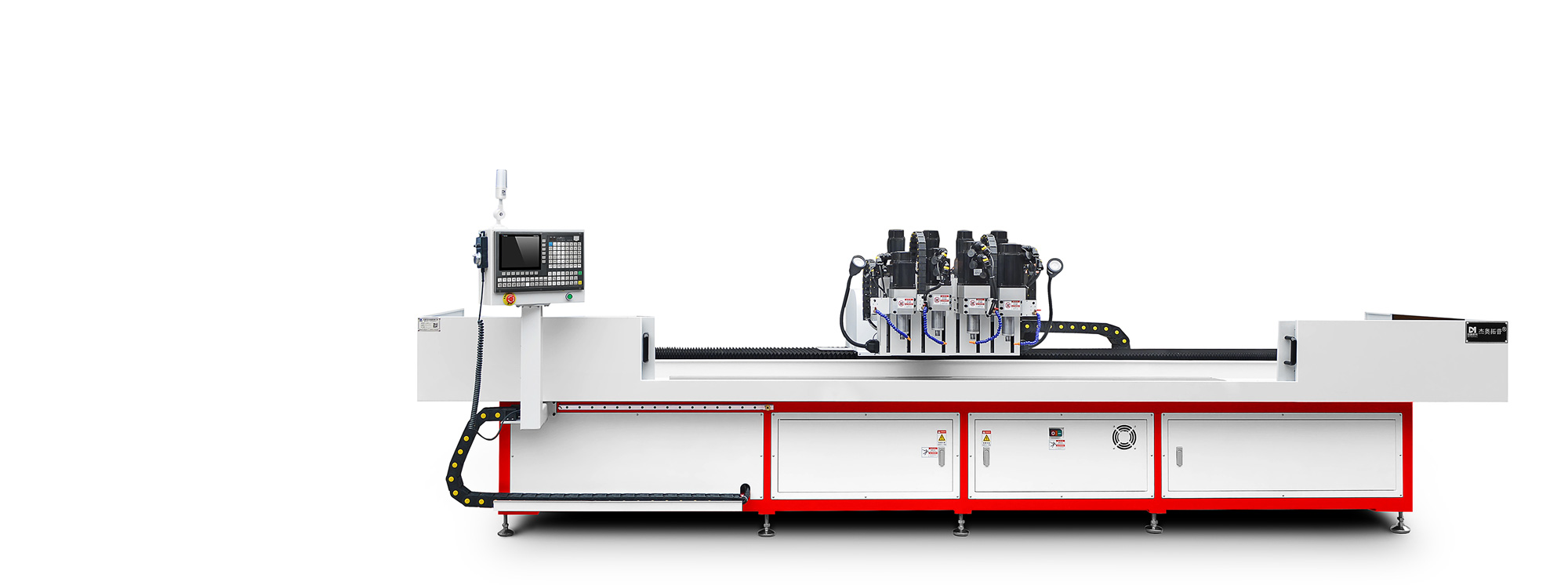
Machine Model: DNC-7003DT(R1) | 4-Axis CNC Pipe Drilling & Tapping Machine Manufacturer: Duomi CNC Industry: Oil & Gas — Downhole Equipment Manufacturing Customer Reference: Weatherford International (global oilfield services, 90+ countries) Original article published at:https://www.xdmcnc.com/landing-4-axis-pipe-case.html
Quick Results at a Glance
Before this machine, operators were losing up to 60% of total job time to manual re-clamping, repositioning, and tool changes. Broken drill bits on 6,500mm+ stator tubes were a daily event. Here is what changed.
|
Metric
|
Before
|
After
|
Improvement
|
|
Hole-positioning error (angular)
|
±0.5°–1.5° (manual indexing)
|
±30 arc-seconds (servo drive)
|
~100× more accurate
|
|
Re-clamping per workpiece
|
4–6 times
|
1 time
|
Zero re-clamping
|
|
Broken drill bits per shift
|
3–5 incidents
|
Near zero
|
~95% reduction
|
|
Machining cycle per stator tube
|
Baseline = 100%
|
~45% of original time
|
55% faster
|
|
Batch-to-batch consistency
|
Operator-dependent
|
Program-repeatable
|
Full traceability
|
|
API / ISO compliance rate
|
Variable
|
±0.02mm positional accuracy
|
Meets API 11B standard
|
Results based on real-world stator tube applications. Actual figures vary by tube spec and material.
The Problem: Stator Tubes Are a Machinist's Nightmare
Oil downhole equipment — specifically the stator tubes used in progressing cavity pumps (PCP) — presents one of the most demanding drilling and tapping challenges in metal fabrication.
Here is what makes them so difficult:
They are extremely long. Stator tubes for companies like Weatherford regularly exceed 6,500mm in length. Most standard machining centers have an X-axis travel of 2,000mm or less. The tube simply does not fit.
They need holes all the way around. M12 or larger threaded holes must be distributed evenly around the full circumference, at precise angular intervals. One missed angle and the assembled pump leaks or fails in the well.
They vibrate when you drill them. A 6,500mm steel tube clamped only at its 2 ends behaves like a tuning fork. The moment the drill bit pushes down, the middle of the tube deflects and vibrates — a condition machinists call chatter. Chatter breaks drill bits. It also ruins thread quality.
The material fights back. Stator tubes are typically made from alloy or quenched-and-tempered steel, with hardness in the HRC 25–35 range. Heat builds up fast in blind holes. Chips pack in. Tools wear out quickly.
The Bottleneck: Standard Machines Cannot Handle This Job
Before switching to a dedicated CNC pipe drilling and tapping machine, Weatherford-tier suppliers typically ran stator tube jobs on general-purpose equipment. The process looked like this:
-
Clamp the tube on a conventional lathe or milling table
-
Mark hole positions manually with a scribe and center punch
-
Drill with a handheld or bench drill press
-
Re-clamp, rotate by hand using a mechanical dividing head
-
Repeat for every hole — often 12 to 24 holes per tube
-
Switch tools, re-align, tap each hole separately
This process created 4 compounding problems:
Problem 1 — Accumulated positioning error. Every manual re-clamp shifts the tube slightly. By the 6th hole, the angular deviation can reach 1° or more. On a tube that must meet API 11B tolerances, that is a scrap part.
Problem 2 — No mid-span support. No standard fixture supports the middle of a 6,500mm tube. The tube hangs in the air between 2 clamp points. Every drill stroke makes the tube flex. Broken drill bits are not accidents — they are inevitable.
Problem 3 — Two separate tool setups. Drilling and tapping require different spindles, different speeds, and different alignments. Switching between them takes 10–20 minutes per setup, and every switch introduces a new alignment error.
Problem 4 — Zero repeatability. Each tube relies on the operator's skill and attention. One tired machinist, one slightly loose clamp, and the whole batch fails inspection — which, for Weatherford, can mean full-batch rejection under API audit.
The Solution: A 4-Axis CNC Rotary Table Drilling Machine Built for This Exact Job
The DNC-7003DT(R1) is a purpose-built CNC pipe drilling tapping combo machine. It was designed specifically for long-tube, multi-angle, high-precision work. Here is what it does — and what each feature means in practice.
1. Dual Spindle on One Carriage — Drilling and Tapping Without Changing Tools
The machine carries 2 independent spindles on the same Z-axis carriage — 1 dedicated drilling spindle and 1 dedicated tapping spindle. Each can extend downward independently.
What this means for the operator: After the drill spindle finishes a hole, the tapping spindle moves into position over the same hole and taps it immediately. No tool swap. No re-alignment. The drill axis and tap axis share the same positional reference, so the tap follows the exact center of the drilled hole every time.
One carriage. 2 spindles. Drilling and tapping done in the same stop.
2. 4th Axis Rotary Table — 360° Servo Indexing, Zero Manual Handling
The tube sits in a servo-driven 4th-axis chuck at one end. The rotary axis uses a high-precision harmonic reducer, giving it an angular positioning accuracy of ±30 arc-seconds.
What this means for the operator: The CNC program tells the machine exactly what angle to rotate to before each hole. The tube turns automatically. No operator needed between holes. A 12-hole circumferential pattern that used to require 12 manual re-clamp steps now runs in 1 uninterrupted CNC cycle.
This is what the industry calls a 4-axis CNC machine (X + Y + Z + rotary A-axis). For stator tube work, it solves the angular accuracy problem completely.
3. 6 Mid-Span Steady Rests — The Feature That Stops Broken Drill Bits
This is the feature most competing machines skip — and the reason drill bits keep breaking on long tubes.
The DNC-7003DT(R1) comes with 6 fixed steady rests (also called center rests or workpiece supports) distributed along the length of the machine bed. Each rest cradles the tube at a fixed point along its 6,800mm span.
Why does this work? A tube supported only at 2 ends acts as a flexible beam. When a drill bit pushes down at the midpoint, the tube deflects. The deflection creates vibration. Vibration breaks drill bits and tears up thread walls.
Adding mid-span support changes the physics. Each additional support point cuts the effective unsupported span in half. According to basic beam theory, halving the span reduces deflection by a factor of 16 (deflection scales with the 4th power of span length). With 6 steady rests along 6,500mm, the tube becomes rigid enough to machine like a solid block.
In plain terms: The steady rests are the reason this machine can drill and tap a 6,500mm steel tube without a single broken drill bit in a full production run.
No steady rests → tube vibrates → broken bits, ruined threads.
6 steady rests → tube stays rigid → clean holes, clean threads, every time.
4. 6,800mm X-Axis Travel — The Only Standard Way to Machine This Workpiece
The machine bed runs 6,800mm along the X-axis. Both the drilling carriage and the tapping carriage travel the full length independently.
What this means: A 6,500mm stator tube loads onto the machine in 1 fixture. The spindle carriage moves to each hole position automatically. No repositioning. No re-referencing. The full tube is machined in 1 setup.
No standard vertical machining center, no conventional CNC milling machine, and no general-purpose lathe can replicate this. The DNC-7003DT(R1) is, in practical terms, purpose-built for workpieces that other machines cannot accept at all.
5. ±0.02mm Positional Accuracy — API-Certified From the Factory
Every DNC-7003DT(R1) unit goes through laser interferometer calibration before shipping. DuoMi uses an American API-standard laser interferometer system to measure and compensate for positioning errors across the full 6,800mm travel.
The result: ±0.02mm positional accuracy across the full X-axis stroke. That is roughly one-third the width of a human hair — and well within the tolerance bands required by API 11B and ISO 15136 for downhole equipment.
DuoMi holds a CE certificate covering this machine series. The laser calibration report ships with every machine as part of the quality documentation package, supporting the traceability records that major oil service companies require for supplier audits.
6. Flood Coolant System — Longer Tool Life, Faster Chip Clearance
A programmable flood coolant system aims cutting fluid directly at the drill and tap during operation. On alloy steel and quenched steel tube materials, coolant does 3 things simultaneously:
-
Pulls heat away from the cutting edge, extending drill and tap life
-
Lubricates the tap flutes during threading, reducing tapping torque and broken tap incidents
-
Flushes chips out of the hole before they pack and cause re-cutting damage
What this means in numbers: Tool life on HRC 30+ alloy steel improves significantly with consistent flood coolant. Broken taps — which can require 30+ minutes to extract and often destroy the workpiece — become a rare event rather than a daily frustration.
7. Can Machine Multiple Materials
The machine handles all common industrial metals: iron, copper, aluminum, brass, steel, zinc, platinum, and alloys thereof. For stator tube applications, this covers the full range of materials used in both conventional and metal-stator PCP configurations.
8. CE Certified + Full Custom Engineering
Every machine in the DuoMi lineup carries CE certification and ships with an API laser interferometer calibration report.
Beyond the standard spec, every unit is available for custom configuration. Spindle spacing, chuck size, steady rest count, axis travel, and control software can all be adjusted to match the customer's specific tube dimensions and hole patterns. This is not a modified standard machine — it is a purpose-built solution engineered around the customer's production requirements.
Results: What This Machine Actually Delivers for Oil & Gas Manufacturers
The table below compares a typical stator tube job run on conventional equipment versus the DNC-7003DT(R1):
|
Category
|
Conventional Process
|
DNC-7003DT(R1)
|
Impact
|
|
Machine setup
|
Manual indexing + multiple fixtures
|
1 CNC program load
|
Setup time cut by ~70%
|
|
Clamping operations per tube
|
4–6 manual re-clamps
|
1 fixture load
|
Eliminates re-clamp error
|
|
Angular hole accuracy
|
±0.5°–1.5°
|
±30 arc-seconds
|
~100× improvement
|
|
Positional accuracy (XY)
|
±0.1–0.3mm (operator-dependent)
|
±0.02mm (laser-calibrated)
|
Consistent API compliance
|
|
Broken drill bits per shift
|
3–5
|
Near zero
|
Tool cost drops sharply
|
|
Broken taps per shift
|
1–2
|
Near zero
|
Eliminates 30-min+ extraction downtime
|
|
Batch consistency
|
Operator-dependent
|
Program-repeatable
|
Audit-ready traceability
|
|
Tubes per shift (12-hole pattern)
|
2–3
|
4–6 (estimated)
|
~55% more output
|
|
Scrap rate
|
High (re-clamp errors accumulate)
|
Low (single-setup, program-controlled)
|
Fewer rejected parts
|
Why This Matters for Weatherford-Tier Suppliers
Weatherford operates in 90+ countries and manufactures or sources stator tubes at high volumes for progressing cavity pump systems. Their supplier requirements include:
-
API 11B / ISO 15136 dimensional compliance on every part
-
Full batch traceability with dimensional inspection records
-
Consistent inter-changeability — tubes made in different facilities must fit the same pump without adjustment
-
On-time delivery — oil production does not pause for late parts
The DNC-7003DT(R1) addresses all 4 requirements directly. The laser interferometer calibration report and CE documentation support audit submissions. The program-based CNC cycle guarantees batch-to-batch repeatability. The single-setup workflow compresses lead time. And the 6 steady rests make it physically possible to hold API tolerances on tubes that would otherwise vibrate out of spec.
Specifications Summary
|
Spec
|
Value
|
|
Model
|
DNC-7003DT(R1)
|
|
XYZ Axis Machining Stroke
|
X 6800mm, Z 200mm, A 360°
|
|
Repeated Positioning Accuracy
|
± 0.02mm
|
|
X axis moving speed
|
30m/min~60m/min
|
|
Z axis moving speed
|
25m/min
|
|
Guide Rails & Ball Screws
|
HIWIN (Taiwan) / PMI Precision Grade
|
|
Drilling / Tapping Diameter
|
M2~M16
|
|
Borehole diameter range
|
1~20mm
|
|
Spindle Power
|
0.55~3.0KW
|
|
Spindle Speed
|
1500~24000rpm(Can be selected according to demand)
|
|
Chunk specifications
|
ER20
|
|
Programming Mode
|
CAD file import / Computer programming / Manual
|
|
Dimension(L*W*H)
|
8200mm*1500mm*1700mm
|
|
Operating voltage
|
AC 220V/50HZ
|
Is This Machine Right for Your Operation?
This machine is the right fit if your shop faces any of these situations:
-
You machine tubes or pipes longer than 2,000mm with circumferential hole patterns
-
Your operators break drill bits or taps regularly on long-tube jobs
-
You supply to oil & gas customers who require API or ISO dimensional compliance
-
You lose time to manual re-clamping and indexing between holes
-
You need batch traceability to pass supplier audits
Duomi CNC · DNC-7003DT(R1) · CE Certified · API Laser CalibratedCustom configurations available. Contact Duomi for tube-specific engineering consultation.