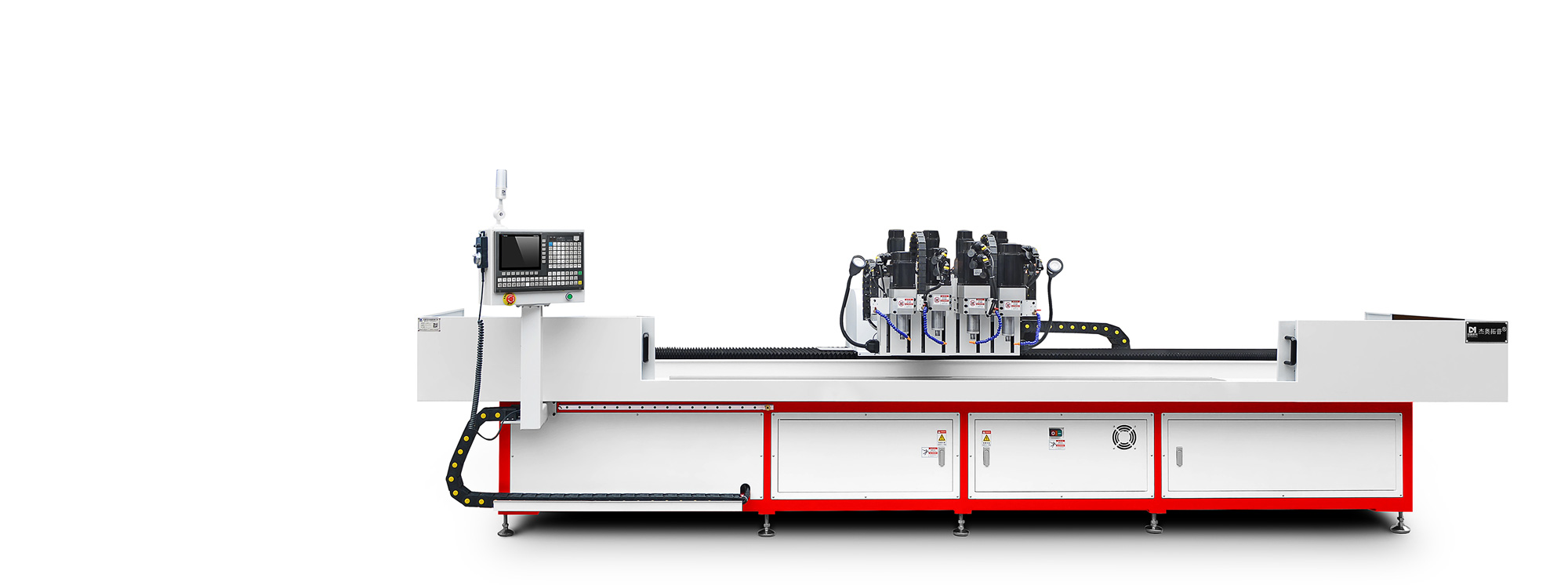
After switching to the four-spindle horizontal drilling and tapping machine, the customer reported noticeable improvements in dimensional repeatability.
1. Industry Background: Structural Component Production
Manufacturers of structural metal components face increasing pressure to balance productivity with dimensional consistency. These components are widely used in equipment frames, support brackets, modular structures, and mechanical enclosures. Most of them are produced from long steel or aluminum profiles that require multiple threaded holes arranged along one or two surfaces.
In this industry, drilling and tapping are not secondary operations but core machining steps. Hole position accuracy determines whether the components can be assembled without additional adjustment. Thread quality directly affects fastening strength and long-term stability. As order volumes grow, traditional single-hole processing methods become difficult to scale.
For this reason, many workshops have started to adopt equipment capable of performing several machining actions in one cycle. In this case, the customer selected a four-spindle horizontal drilling and tapping machine to match the characteristics of their product range.
Application of Four-Spindle Drilling Machine in Structural Manufacturing
2. Typical Machining Challenges in This Sector
Before introducing the new equipment, the customer relied mainly on conventional drilling machines and single-spindle CNC units. This setup created several limitations:
Frequent Repositioning
Long workpieces had to be clamped and unclamped repeatedly to reach different hole locations. Each repositioning increased the risk of misalignment.
Inconsistent Hole Spacing
Manual positioning depended on operator experience, which caused small variations between batches.
Low Throughput for Large Orders
When production demand increased, cycle time per part became the main bottleneck.
These challenges are common in workshops producing structural components for industrial use. The need for a more efficient method led the customer to consider a four-spindle horizontal drilling and tapping machine as a long-term solution.
3. Why Horizontal Multi-Spindle Machining Fits This Industry
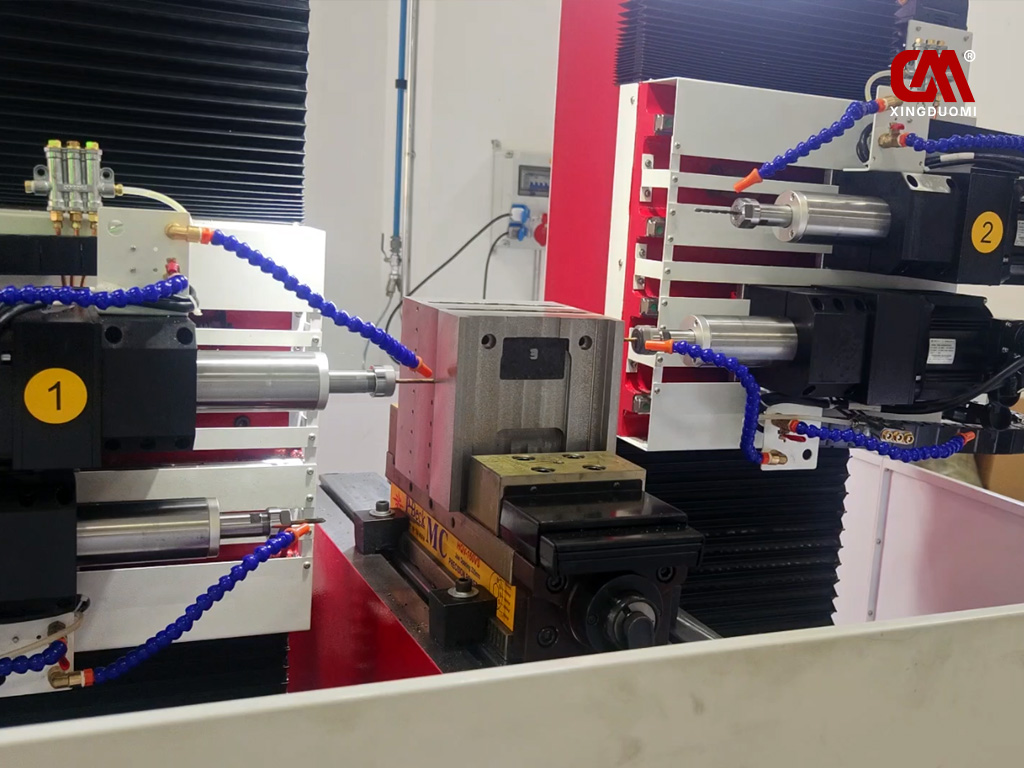
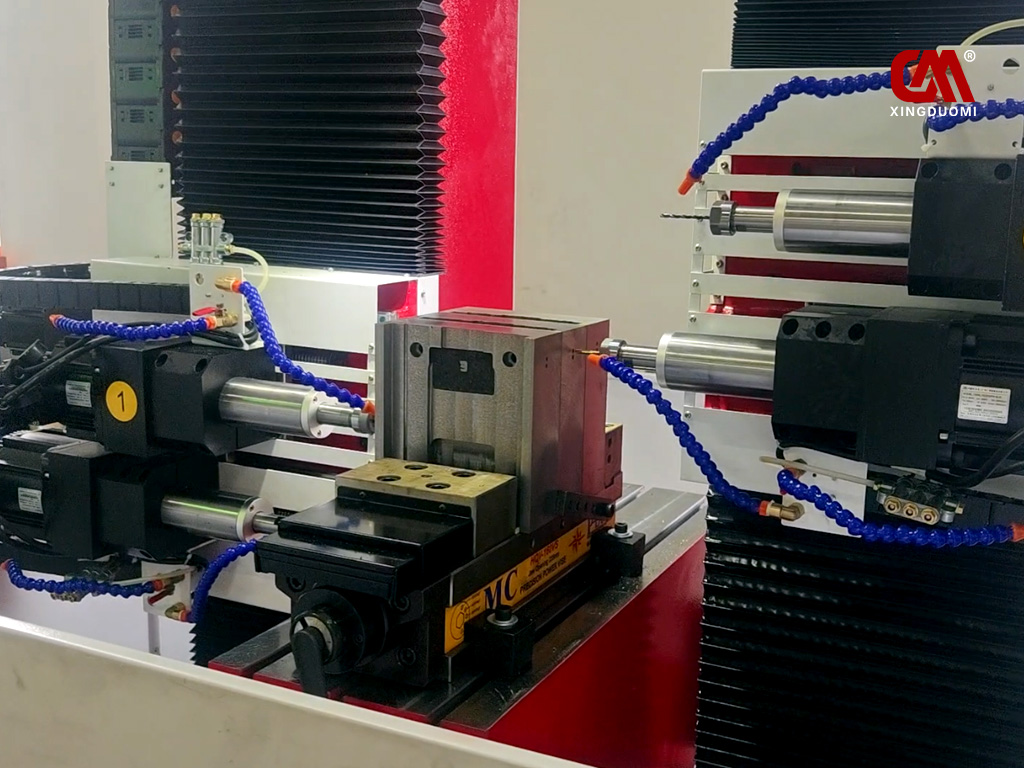
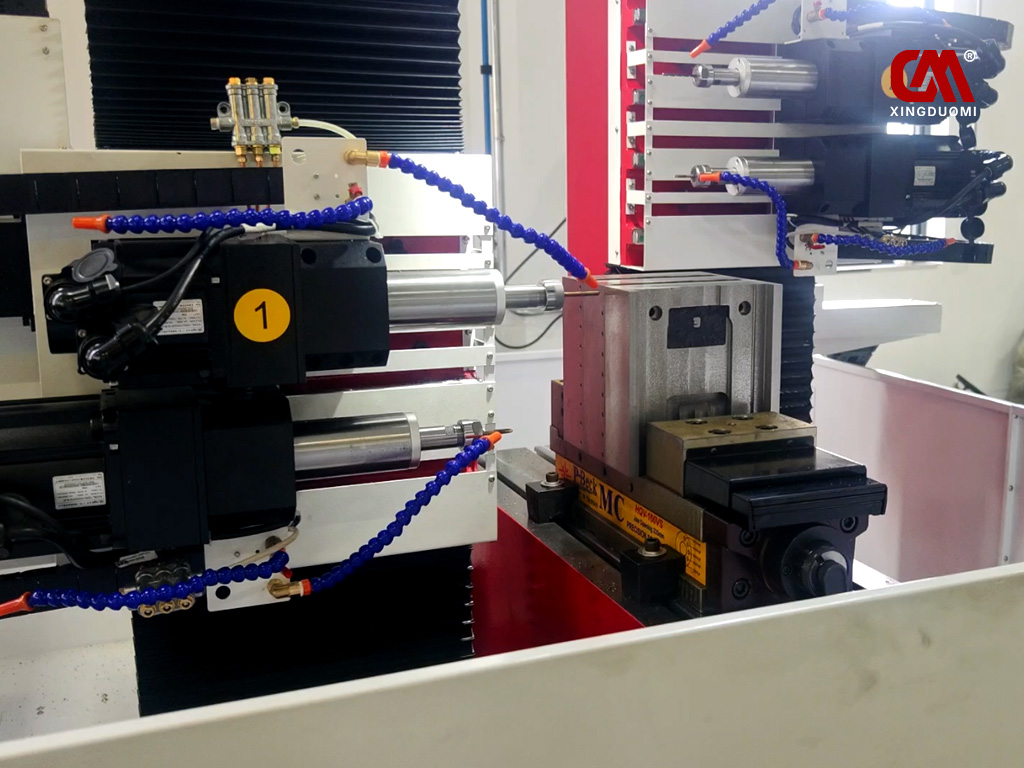
Unlike vertical equipment, horizontal machines support long profiles along their length. This layout reduces bending and vibration during drilling and tapping. In addition, multiple spindles can work simultaneously on different hole positions.
For this customer's application, the four-spindle horizontal drilling and tapping machine offers three structural advantages:
The workpiece remains fixed during machining.
Several holes are processed in one cycle.
The machining direction matches the geometry of the profile.
This configuration is particularly suitable for rectangular tubes and channel-shaped parts used in industrial frames and mounting systems.
4. Integration into the Customer's Production Flow
After installation, the machine was assigned to the customer's main production line for structural parts. Instead of treating it as a separate unit, it was integrated into the standard workflow:
Profiles are cut to length.
Parts are transferred to the drilling and tapping station.
Holes and threads are machined in one operation.
Finished parts move directly to welding or assembly.
By introducing the four-spindle horizontal drilling and tapping machine, the customer simplified the sequence of operations. The machining stage became more predictable, which helped stabilize the entire production line.
Four-Spindle Drilling and Tapping Machine for Structural Parts
5. Impact on Product Consistency
In structural applications, hole alignment affects how parts fit together. Even small deviations can lead to stress during assembly or require manual correction.
After switching to the four-spindle horizontal drilling and tapping machine, the customer reported noticeable improvements in dimensional repeatability. Since the machine follows the same programmed path for every part, hole positions remained uniform across different batches.
Thread depth and pitch also became more consistent, reducing the risk of loose fasteners during assembly. This consistency is particularly important for products that are shipped as modular systems and assembled at customer sites.
6. Productivity Changes in Daily Operation
From a production planning perspective, the new equipment changed how orders were scheduled. Previously, long parts required extended machining time because each hole was processed separately.
With the four-spindle horizontal drilling and tapping machine, several holes are completed in one cycle. This reduced the average machining time per part and made daily output more predictable.
Operators were able to focus on material handling rather than frequent adjustments. This shift reduced idle time and allowed the workshop to handle larger batch sizes without increasing labor.
7. Application Examples in Structural Manufacturing
The customer's product range includes:
Support frames for industrial equipment
Mounting brackets for mechanical systems
Rectangular tube components for enclosures
Reinforcement parts for modular structures
All these parts share a common requirement: multiple threaded holes positioned along long surfaces.
The four-spindle horizontal drilling and tapping machine fits these applications by combining drilling and tapping into a single controlled process. This eliminates intermediate steps and improves alignment accuracy between holes.
Structural Component Machining with Four-Spindle Drilling Machine
8. Quality Control in Industry Use
In structural component manufacturing, quality control focuses mainly on hole position, thread quality, and surface condition.
After adopting the four-spindle horizontal drilling and tapping machine, inspection results showed stable hole spacing and uniform thread profiles. The reduction in manual adjustment also lowered the probability of human error.
This improvement allowed the customer to reduce rework and scrap rates, which had a direct impact on material utilization and delivery schedules.
9. Long-Term Value for the Customer's Industry Segment
Beyond immediate productivity gains, the customer viewed the machine as an investment in production standardization. The four-spindle horizontal drilling and tapping machine enables them to process different part types using the same machining principle.
This flexibility is important for workshops serving multiple industrial sectors, where product dimensions change but machining logic remains similar.
By maintaining consistent drilling and tapping quality, the customer strengthened their ability to meet industry tolerances and contract requirements.
10. Industry Trend Toward Multi-Process Equipment
Structural component manufacturers increasingly look for machines that reduce setup time and combine operations. The use of multi-spindle systems reflects this trend.
The four-spindle horizontal drilling and tapping machine represents a shift from step-by-step machining to synchronized processing. This approach aligns with modern manufacturing strategies that emphasize:
Stable quality
Reduced manual intervention
Predictable production cycles
For this customer's industry, such changes are becoming necessary to remain competitive.
11. Customer Perspective on Industry Application
From the customer's viewpoint, the value of the machine lies in how it fits their product type rather than its technical specifications alone. Their main feedback focused on:
Better hole alignment for long parts
Easier integration into existing production lines
Improved consistency for assembly operations
These points highlight that the four-spindle horizontal drilling and tapping machine serves as a practical tool for meeting industry-level requirements rather than just increasing speed.
12. Conclusion
This application case demonstrates how a four-spindle horizontal drilling and tapping machine can support the specific needs of structural component manufacturing. By addressing common challenges such as repositioning, alignment variation, and low throughput, the machine improves both productivity and quality.
Rather than functioning as isolated equipment, it becomes part of a coordinated production system tailored to long-profile parts with repetitive hole patterns. For manufacturers in this sector, adopting such equipment represents a step toward more standardized and reliable machining practices.
As production volumes increase and tolerance demands grow stricter, the role of multi-spindle horizontal machining is expected to expand within this industry.